+86-25-58599930


Silicone fluid selection can have a direct effect on release behavior, lubrication efficiency, surface feel, spreading, and compatibility with downstream processes. Although silicone fluids are often associated with low surface energy and excellent slip, different molecular structures and viscosity grades can produce substantially different results in practical formulations.
The right material therefore depends on what the formulation actually needs to accomplish. A release coating may require rapid spreading and controlled film formation, while a lubricant may prioritize persistence and shear stability. A textile treatment may need surface conditioning, whereas an adhesive formulation may need to minimize silicone migration to preserve subsequent bonding.
Viscosity is one of the first properties formulators should consider because it influences spreading, mobility, film thickness, and persistence on a substrate.
Lower-viscosity fluids generally move and spread more easily. They can provide rapid surface coverage and are useful when the formulation must wet a relatively large area quickly.
Higher-viscosity fluids typically show greater resistance to flow and can remain on a surface for longer periods. This can be advantageous when a persistent lubricating or release film is required.
However, viscosity should not be evaluated independently. Temperature, shear rate, substrate energy, concentration, and compatibility with the surrounding formulation can all influence actual surface performance.
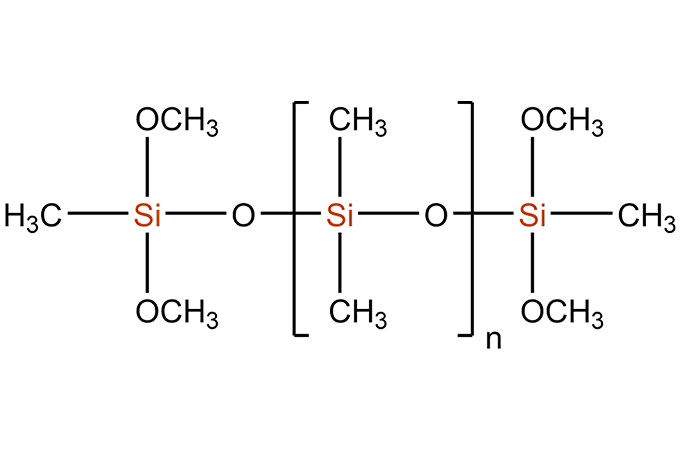
The siloxane backbone provides silicone fluids with characteristic properties such as low surface energy, flexibility, and resistance to a wide range of environmental conditions. However, changes to the molecular structure can significantly alter compatibility, polarity, migration, and interaction with substrates.
Conventional silicone fluids are generally selected when physical surface effects such as slip, release, spreading, or lubrication are the primary objectives.
Functionalized silicone fluids introduce additional chemical groups that can change how the material interacts with fibers, coatings, polymers, or other substrates.
Consequently, formulators should first determine whether the application requires simple surface modification or a more controlled interaction between the silicone fluid and the substrate.
Silicone oil is widely considered when a formulation requires low surface energy, smooth lubrication, release, or slip. Silicone fluids can also provide useful resistance to temperature and moisture, depending on their molecular structure and formulation.
For release applications, the fluid must spread sufficiently to establish a uniform low-adhesion interface. For lubrication, it must maintain an effective film under the expected pressure, temperature, and shear conditions.
The practical challenge is finding the right balance between surface coverage and film persistence. A fluid that spreads extremely quickly may not remain on the surface long enough, while an excessively viscous material may be difficult to distribute uniformly.
In mold-release applications, silicone fluid reduces the interaction between the mold surface and the processed material by creating a low-energy interfacial layer.
Effective release depends on more than simply lowering adhesion. The fluid should form a consistent film without creating excessive transfer to the molded component.
Excessive transfer can become a downstream problem if the molded part must later be painted, printed, coated, bonded, or otherwise surface-treated.
For this reason, release testing should evaluate both demolding performance and the cleanliness or surface energy of the released component.
Dimethyl silicone oil is a useful baseline material when low surface energy, slip, release, and lubrication are required without introducing a strongly reactive functional group.
Different viscosity grades provide different balances between mobility and persistence. Lower-viscosity grades can spread efficiently across a surface, whereas higher-viscosity grades can provide a more persistent film.
Selection should therefore be based on the application rather than assuming that one viscosity is universally superior.
Functional silicone fluids become more valuable when the formulation requires controlled interaction with a substrate rather than only physical lubrication.
For example, amino-functional silicone materials can provide additional affinity toward certain substrates because the amino functionality changes the chemical interaction of the silicone molecule.
Amino silicone fluids are therefore commonly considered for applications where surface conditioning, softness, smoothness, or substrate retention is important.
The additional functionality can improve performance, but it also changes formulation behavior. Compatibility, storage stability, dosage, and the possibility of surface migration should all be evaluated before scale-up.
| Property | Effect on performance | Key selection question |
|---|---|---|
| Viscosity | Spreading, mobility, and film persistence | Will the fluid distribute and remain effectively? |
| Surface tension | Wetting and surface coverage | Can it form a sufficiently uniform film? |
| Molecular structure | Compatibility and surface behavior | Is a conventional or functional fluid more suitable? |
| Functional groups | Substrate interaction | Is chemical affinity required? |
| Volatility | Retention and processing behavior | Will the fluid remain where it is needed? |
| Thermal stability | Performance during elevated-temperature processing | Will the surface film remain stable? |
Migration can be beneficial when controlled movement toward the surface is part of the intended mechanism. However, uncontrolled migration can create significant formulation problems.
In coatings, excessive migration may cause surface defects or reduce intercoat adhesion. In adhesive systems, silicone contamination can lower surface energy and interfere with bonding. In molded components, transferred silicone can affect printing or painting.
The objective should therefore be controlled surface activity rather than maximum migration.
Release and adhesion are often competing requirements. Increasing silicone surface activity can make a surface easier to release from, but the same reduction in surface energy can make subsequent bonding more difficult.
This trade-off is particularly important when a component must first pass through a release process and later undergo painting, coating, printing, or adhesive assembly.
A practical approach is to use the lowest effective silicone concentration that provides the required release or lubrication effect. The treated surface should then be evaluated for downstream adhesion under realistic processing conditions.
No. Increasing silicone concentration may initially improve spreading, slip, or release, but the benefit eventually reaches a practical limit.
Beyond that point, additional silicone can increase migration, cause surface defects, interfere with adhesion, or negatively affect the stability of the formulation.
Optimization should therefore identify the minimum effective dosage rather than maximizing silicone content.
Laboratory testing should reproduce the actual substrate, application method, temperature, shear, and environmental conditions as closely as possible.
Depending on the application, useful measurements may include coefficient of friction, release force, surface tension, contact angle, film persistence, viscosity, migration, adhesion after treatment, and aging performance.
For lubrication applications, testing should also consider load, speed, temperature, and duration because a silicone fluid that performs well under static conditions may behave differently under continuous mechanical stress.
The most reliable selection process begins with the required function. Determine whether the primary objective is release, lubrication, slip, spreading, leveling, surface conditioning, or a combination of several effects.
Next, evaluate molecular structure, viscosity, functional groups, compatibility, thermal stability, and migration characteristics.
Finally, test the selected material under realistic operating conditions and examine both immediate performance and downstream effects.
In practice, the best silicone fluid is the one that provides the required surface effect while remaining compatible with the complete formulation and production process. A controlled balance between surface activity, persistence, mobility, and compatibility is usually more valuable than maximizing any single specification.



 English
 日本語
日本語 한국어
한국어 français
 Deutsch
 Español
 italiano
 русский
 português
 العربية
 tiếng việt